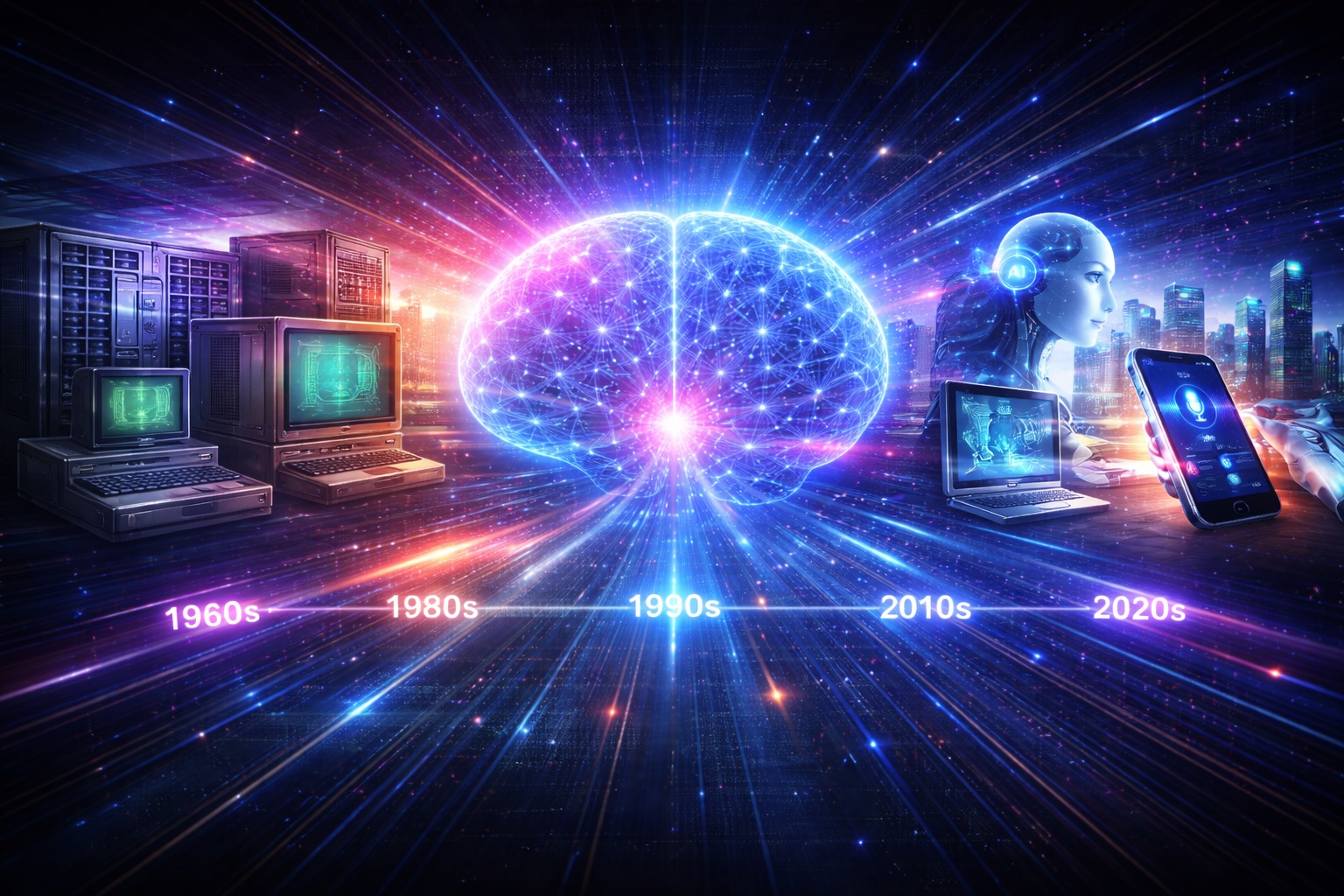
1950s – The first ideas
The modern history of artificial intelligence began in the 1950s. Mathematician Alan Turing asked the fundamental question: Can machines think? His Turing Test proposed a way to examine whether a machine could convincingly imitate human behaviour.
At the same time, the first computer programs capable of solving simple logical problems appeared. Researchers were highly optimistic and believed thinking machines might be only a few years away.
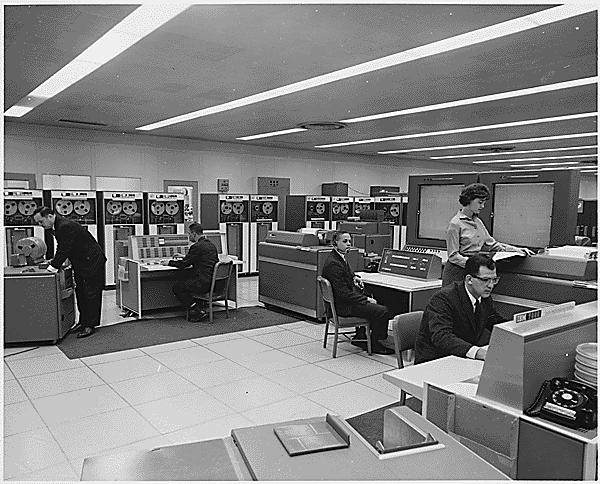
However, computers were still slow, expensive and had very limited memory. Even so, this period created the foundation for future AI research.
1960–1970 – Early AI systems
During the 1960s and 1970s, the first genuine AI systems were created. Programs could solve mathematical problems, play chess and process simple language.
Many systems relied on fixed rules and logical structures. Researchers tried to represent human knowledge using if-then rules.
It soon became clear that the real world was too complex for rigid rule systems. Unexpected situations quickly exposed their limitations.
Nevertheless, important foundations such as search algorithms, decision trees and early learning models were developed.
1980s – The AI winter
During the 1980s, AI research experienced a major setback. Many projects failed to meet their ambitious expectations, causing funding and investment to decline.
Companies and governments partly lost confidence in the technology. Systems were expensive, inflexible and often useful only for narrowly defined tasks.
Research did not disappear, however. Neural networks and new mathematical methods continued to develop in the background.
The AI winter demonstrated that technological progress is rarely linear.
1997 – Deep Blue defeats Kasparov
In 1997, IBM computer Deep Blue defeated world chess champion Garry Kasparov.
For the first time, a machine defeated one of the best human players in an extremely complex game. The event attracted worldwide attention.
Deep Blue primarily relied on enormous computing power, extensive chess data and specially developed search algorithms. It was not a general learning AI.
Nevertheless, the victory fundamentally changed public perceptions of artificial intelligence.
From 2010 – The machine-learning boom
From around 2010, modern AI began its major breakthrough. The key factors were greatly increased computing power and huge amounts of data.
The internet provided enormous collections of text, images and other information. At the same time, processors and graphics cards became increasingly powerful.
Systems were now able to learn from examples instead of relying solely on fixed rules. Machine learning and deep learning led to major advances in image recognition, speech, translation and navigation.
This development forms the basis of many current AI applications.
From 2020 – Generative AI
Since around 2020, generative AI has moved into the spotlight. Systems can create text, images, music, programming code and video.
AI is no longer only used in the background, but has become directly accessible to millions of people.
Tools such as ChatGPT, DALL·E and other generative systems are changing work, education, creativity and communication.
At the same time, new questions are emerging around copyright, responsibility, employment, privacy and wider social effects.