


Open category
Most recreational flights and many low-risk commercial flights take place in the open category. Prior operational authorisation is normally not required if all conditions are met.
Equipment / Drones
The most important basics for safe and legal drone flights in Europe, Spain and Switzerland.
European rules divide drone operations into three categories according to risk: open, specific and certified.
Most recreational flights and many low-risk commercial flights take place in the open category. Prior operational authorisation is normally not required if all conditions are met.
If a condition of the open category cannot be met or the operational risk is higher, the flight will normally fall into the specific category. Authorisation or an operational declaration may be required.
This category covers operations with particularly high risks, such as certain transport services or complex professional applications. It is rarely relevant for normal recreational flights.
The drone must generally remain within direct visual line of sight. A video image on the controller does not replace visual contact.
In the open category, the general maximum altitude is 120 metres above the closest point of the ground. Local geographical zones may impose lower limits or additional conditions.
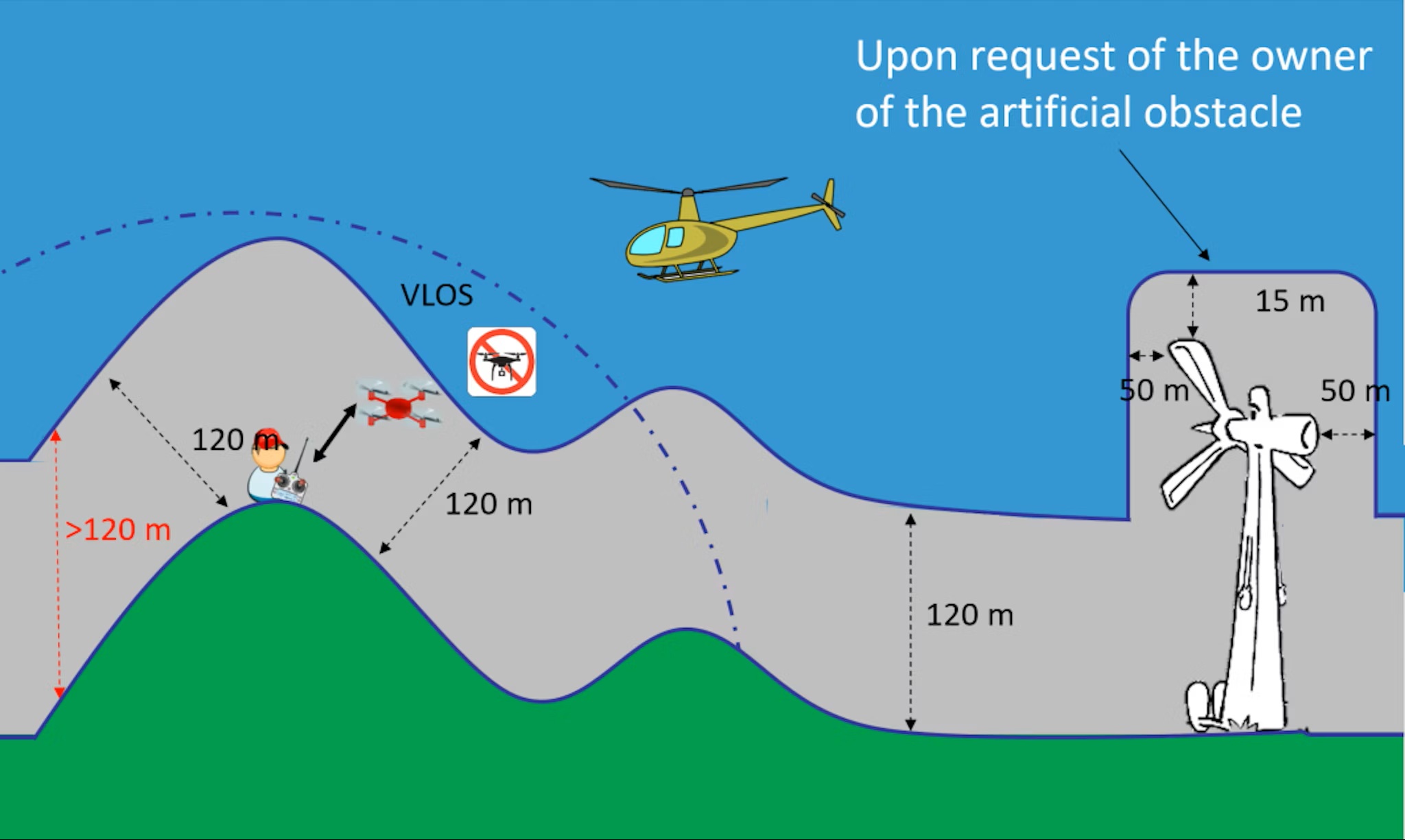
General illustration of the 120-metre rule.
Flying over assemblies of people is prohibited in the open category. The rules concerning individual uninvolved people depend on subcategory A1, A2 or A3 and the drone class.
For lightweight drones and certain classes. Depending on the class, uninvolved people must not be overflown or may only be overflown unintentionally and for as short a time as possible. Assemblies of people remain prohibited.
For certain flights closer to uninvolved people, but without flying over them. Distances, drone class and competency requirements must be respected.
For flights far away from uninvolved people and at a substantial distance from residential, commercial, industrial and recreational areas.
It is generally the operator who is registered, not each individual drone. In the open category, operator registration is particularly required if the drone weighs at least 250 grams or is equipped with a camera or sensor capable of capturing personal data, unless it qualifies as a toy.
Within the EASA system, an operator normally registers only once in the state of residence or principal place of business. The operator number is then displayed on the drones or entered into their remote identification system where required.
An operator registration issued by one EASA Member State is generally valid throughout the other EASA Member States. Additional or duplicate registration is not permitted. After a permanent change of residence, operators should check whether their existing registration details must be updated or administratively transferred to the new state of residence.
The required competency depends on drone class, weight and subcategory. For a C0 drone below 250 grams, reading the manufacturer instructions is often sufficient. Other classes and operations may require A1/A3 or A2 competency certificates.
The basic online competency certificate for many flights in subcategories A1 and A3. It normally includes online training and a theoretical examination.
For certain flights closer to uninvolved people. In addition to A1/A3, further knowledge and the required practical self-training are necessary.
Spain applies the European EASA rules together with national provisions and geographical UAS zones. Checking the exact launch location before every flight is therefore essential.
The Spanish Aviation Safety Agency AESA is responsible for operator registration, competency, authorisations and official information.
ENAIRE Drones allows pilots to check geographical UAS zones, flight restrictions, controlled airspace, aerodromes, heliports and other warnings for the planned flight location.
Switzerland largely applies the European drone rules. The responsible authority is the Federal Office of Civil Aviation FOCA; registration, training and examinations are provided through dLIS.
According to FOCA information, drones in the open category may generally be operated in Switzerland from the age of 12. Younger persons may fly under the direct supervision of an appropriately qualified person.
An operator already registered in an EASA state normally does not register again for a temporary flight in Switzerland. The valid operator identifier and competency documents must nevertheless be carried and used correctly.
The permitted subcategory depends on weight, class identification and type of operation. Since 2024, older drones without a class label have more limited possibilities in the open category.
Such drones may generally continue to be operated in A1 if all other conditions are met.
Older drones without a class label may generally only be operated under A3 conditions in the open category, provided they weigh less than 25 kilograms.